
Dubai Oil & Energy Vision 2030: Engineering Transformation Toward a Post-Hydrocarbon Economy


Abstract
Dubai’s Vision 2030 for oil and energy is not centered on expanding crude production, but on transforming its role within the global energy ecosystem. With limited oil reserves compared to neighboring emirates, Dubai has strategically repositioned itself as a hub for energy logistics, refining, trading, and innovation. This journal examines the engineering, infrastructure, and strategic pillars underpinning Dubai’s transition toward a diversified and sustainable energy economy, integrating hydrocarbons with renewable and digital systems.
1. Introduction
Historically, Dubai’s early economic development was supported by modest offshore oil production from fields such as Fateh. However, unlike Abu Dhabi, which holds the majority of the UAE’s oil reserves, Dubai recognized early the need to diversify.
Dubai Vision 2030 builds upon this foresight, focusing on:
- Reducing reliance on oil revenues
- Expanding global trade and logistics
- Investing in advanced energy technologies
Oil remains part of the system—but no longer the center. Instead, Dubai’s strategy is to control the value chain around energy, rather than the raw resource itself.
2. Strategic Role of Oil in Dubai Vision 2030
2.1 From Production to Control of Flow
Dubai produces relatively small volumes of oil, yet plays a critical global role in energy movement.
This includes:
- Storage of crude and refined products
- Re-export through global shipping routes
- Fuel supply for aviation and marine sectors
Infrastructure at Jebel Ali Port enables Dubai to function as a global energy distribution hub, connecting East and West markets.
2.2 Role of Emirates National Oil Company
ENOC is the backbone of Dubai’s oil engineering system.
Its operations include:
- Refining and processing
- Fuel retail networks
- Aviation fuel supply
- Storage and terminal management
From an engineering standpoint, ENOC integrates upstream imports with downstream distribution, ensuring energy availability across sectors.
3. Engineering Infrastructure Supporting Vision 2030
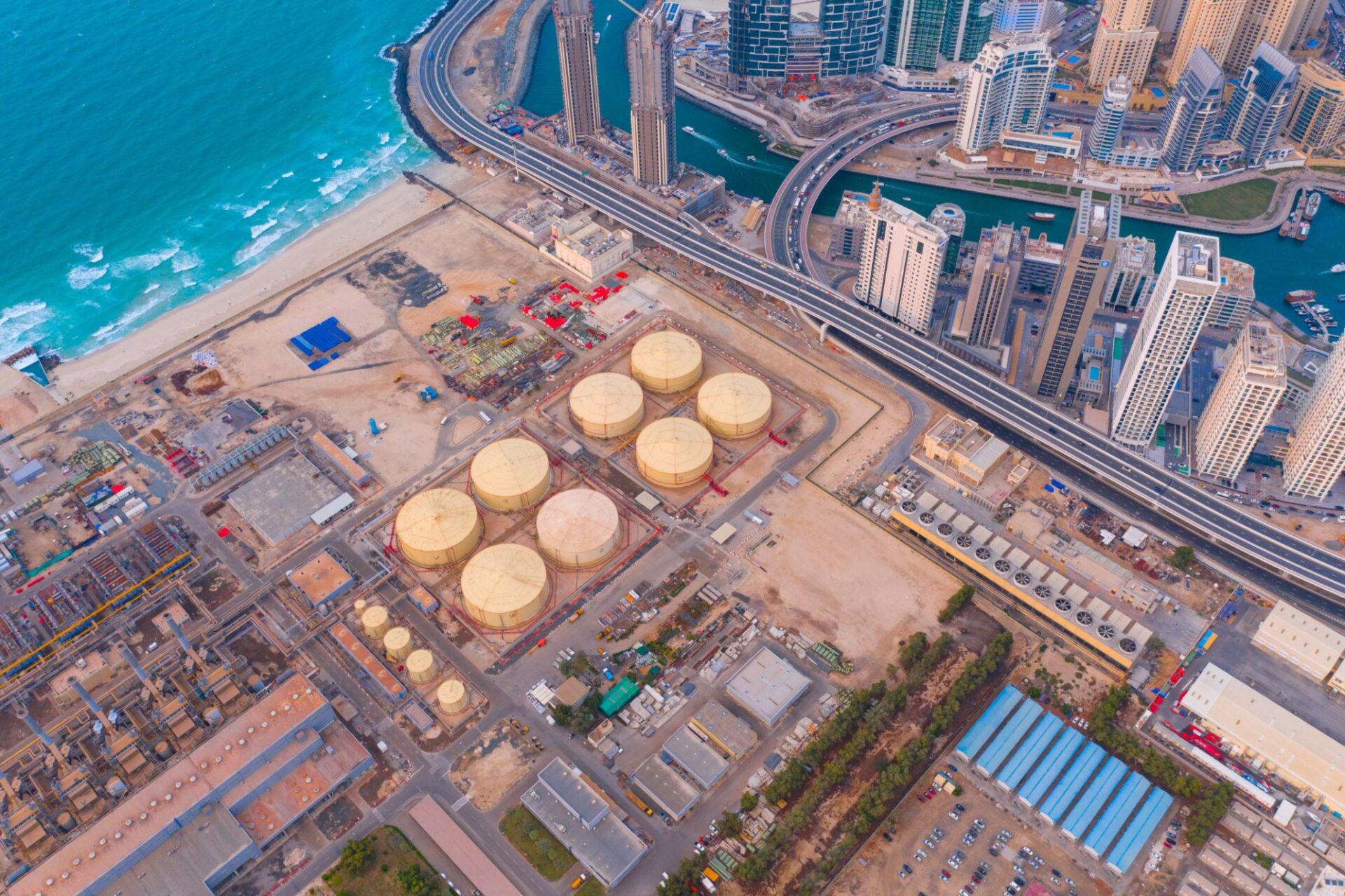
3.1 Storage and Terminal Engineering
Dubai has invested heavily in large-scale tank farms and terminals designed for:
- High-volume throughput
- Minimal product loss
- Safety and environmental compliance
These facilities use:
- Automated loading systems
- Vapor recovery units
- Fire protection engineering systems
3.2 Pipeline and Distribution Networks
Efficient oil movement depends on advanced pipeline engineering:
- Pressure-controlled flow systems
- Leak detection technologies
- Real-time monitoring
Pipelines connect ports, refineries, airports, and industrial zones, forming a fully integrated energy grid.
3.3 Refining and Petrochemical Systems
Dubai’s refining capabilities focus on maximizing value from imported crude.
Engineering systems include:
- Distillation towers
- Hydroprocessing units
- Chemical conversion plants
This allows Dubai to export:
➡️ Refined fuels
➡️ Petrochemical products
➡️ Specialty energy materials
4. Transition to Clean and Hybrid Energy Systems
4.1 Dubai Clean Energy Strategy
Dubai aims to generate a significant portion of its energy from renewable sources.
Key project:
- Mohammed bin Rashid Al Maktoum Solar Park
Engineering features:
- Photovoltaic systems
- Concentrated solar power (CSP)
- Thermal energy storage
4.2 Integration with Oil Systems
Rather than replacing oil, Dubai integrates it with renewables:
- Oil supports base energy demand
- Solar reduces peak load
- Gas improves efficiency
This hybrid model ensures:
- Reliability
- Cost efficiency
- Reduced emissions
4.3 Hydrogen and Future Fuels
Dubai is investing in hydrogen as a next-generation export fuel.
Engineering components:
- Electrolysis units
- Hydrogen storage systems
- Transport infrastructure
Hydrogen positions Dubai for future global energy demand beyond oil.
5. Digital Transformation in Oil & Energy Engineering
Dubai is a leader in applying digital technologies to energy systems.
Key Technologies
- Artificial Intelligence (AI)
- Digital twin modeling
- IoT-based monitoring systems
Applications
- Predictive maintenance of pipelines
- Optimization of refinery operations
- Smart grid energy distribution
This results in:
- Lower operational costs
- Higher efficiency
- Improved safety
6. Economic and Global Strategy
Dubai’s Vision 2030 positions the city as:
- A global energy trading hub
- A financial center for energy investment
- A logistics gateway for oil and gas markets
Energy companies, traders, and investors operate through Dubai, leveraging its:
- Strategic geographic location
- Advanced infrastructure
- Business-friendly environment
7. Challenges and Risk Factors
7.1 Global Energy Transition
- Reduced long-term demand for oil
- Pressure for decarbonization
7.2 Market Volatility
- Oil price fluctuations
- Supply-demand imbalances
7.3 Technological Investment Costs
- High capital required for renewables and hydrogen
8. Future Outlook
Dubai’s energy future is defined by:
➡️ Less dependence on oil production
➡️ More control over global energy systems
➡️ Leadership in innovation and sustainability
The city is evolving into:
A global energy command center rather than a traditional oil producer
Conclusion
Dubai Vision 2030 represents a paradigm shift in oil and energy strategy. By leveraging engineering excellence, infrastructure investment, and forward-looking policies, Dubai has redefined its role in the global energy landscape.
Oil is no longer the destination—it is the foundation for a diversified, technology-driven, and sustainable energy future.
